Posted by: Brian | March 27, 2010

IR (Hood) work.

It took me a few days to actually get the video together but here it is.  This lesson was pretty much nothing but hood work (instrument reference).  This is practice just in case I find myself in clouds, which is not authorized as a VFR pilot, but could happen.  I worked on scanning my instruments, turns, climbs and decents.  I got to experience a bit of spatial disorientation, which was interesting.  Coming out of a standard rate turn, and after leveling out, it felt like I had a right quartering headwind, when in fact we didn’t.  I kept trying to compensate by crabbing into the wind, which didn’t exist.  That meant I had us in a slight right bank.  The learning point there was to really ensure that I trust my instruments during my scan and DON’T trust my senses.  

I am going back up today for a progress check.  That just means that I’ll be going up with another instructor to verify that I am where I need to be and that I am paired properly with my instructor.  If I pass, which I hope I will (and should), I will move on to the next phase of training, nothing but takeoffs and landings, slowing preparing me for my solo!  I am taking my little brother (who leaves for Army Basic Training on 7 April) up with me on Sunday, so that should be fun.  I hope to have footage from a different angle from Sunday’s flight.

UPDATE: I just finished my progress check flight with another instructor and it went very well.  He immediately put me at ease, telling me exactly what it was we’d be doing in the air.  I must say, he was very hands off, simply stating what it was he wanted me to do and then observing.  We spent less than an hour in the air, going over slow flight, stalls, and some steep turns.  Excellent instructor.  Now on to the next phase tomorrow morning!

~ Brian

Total Hours Logged: 12.0 hours

Posted by: Brian | March 21, 2010

Busted 10.

Well, it’s been awhile since I was last able to post about a flight.  This was a great weekend to fly, and I was lucky enough to take advantage of it.  Since I am now out of ground school, my weekends are a bit more open.  I got up yesterday morning for a couple of hours, but had an issue with my camera.  I worked out the kink and was able to get some footage during this mornings lesson.

I am moving right along through my lessons.  Yesterday, the primary focus was ground reference maneuvers.  I just have ‘someone’ to thank for there being virtually no winds.  We worked on turns around a point and S-turns around a road (we selected route 214 for those of you familiar with the area).  I found those quite easy; easier than I thought it’d be anyway.

Today, we took off from Runway 18 and headed out to Deale like we normally do.  The lesson called for some stalls, steep turns and IR (instrument reference) hood work.  Basically, the hood work simulates flying in clouds (the oh sh*t scenario).  About half way through my flight, my instructor handed me a set of ‘foggles’, as I call them.  It’s basically a set of glasses without the glass, and instead has a bill (or hood) to keep your focus on the instruments ONLY.  I thought that I’d do OK, since I played a lot of Microsoft Flight Simulator in the past.  My reasoning was, as a VFR (Visual Flight Rules) pilot, most of your focus is [should] be outside of the airplane.  On computers, your peripheral is severly hampered, so you focus more on the instruments.  As a matter of fact, the first thing my instructor told me was to stop playing my flight simulator until we start ‘hood work’.  Well, now I know why.  It was a bit unnerving not being able to look outside.  There is an interesting scan of the instruments that my instructor taught me, in an effort avoid focusing on one instrument over another.  It was helpful, but I only learned it 2 minutes before heading up in the air.  Needless to say, I became WAY to focused on my attitude and altitude indicators, and wasn’t bouncing (for the most part) that information off of other instruments.  But, I collected 0.5 hours today of hood work and I need 3 total for my license so I still have plenty of time.  No rush, as my wife tells me.  🙂 

On another note, I hit two milestones this weekend.  First, my instructor told me today that I should be able to solo by the end of April!  Some would think that soloing would be the first milestone a private pilot overcomes.  But mine is that knowing my instructor has the FAITH in me to even utter the words ‘solo’ in my presence.  My second milestone is is more of a mile pebble:  I busted 10 hours in the air after this mornings lesson.  🙂 

~ Brian

Total Time: 10.3 hours

Posted by: Brian | March 14, 2010

Part 141 Ground School. Check.

I completed my last session of my Part 141 ground school, which ended with a comprehensive 60 question exam (which I passed!).  We ended the course with some navigational planning.  Being able to put 7 weeks of schooling together at the end was extremely helpful.  The course my instructor had us plan “flew” us from Freeway Airport to Ocean City, NJ (about an hour flight), which included determining weather, plotting waypoints (intersections or checkpoints), computing fuel requirements, headings, landing requirements and time to destination.

Now that I passed the ground school, I can take the FAA written exam, which I will do within the next two weeks or so (after giving myself some time to study a bit more).  Next goal: Solo!  After that, it’s just a matter of getting enough hours in the air and having my instructor endorse me for my checkride.  That is what I am most nervous about: having an FAA examiner in the right seat critiquing my every move for about two hours in the air, not to mention an hour and a half oral exam on the ground prior to even going up.  But that’s what I’m paying my instructor to prepare me for…

I thoroughly enjoyed the class put on by Freeway Aviation and thought the instructor they put before the class was extremely knowledgeable.  He made it interesting.  I imagine that it’s not easy to keep 14 people awake for 7 hours on a Saturday morning (8am – 3pm).  He did a great job, though.  One thing I liked about his instructional style was that he’d give us the ‘book’ answer, then the practical, real-world answer, which is always helpful.  He was always careful to caveat it with, “Now, for your FAA test, you have to do XYZ.  But, once you are on your own, you will probably to do ABC.”

Unfortunately, the weather hasn’t been cooperating very much on the days I have had scheduled as of late.  I was due to go up yesterday after class, but the ceiling is too low, hovering around 300′ AGL with 2 SM visibility (VFR requirement is a 3 SM visibility, with a 1000′ ceiling).  Today, much of the same, but I’m keeping an eye on the Terminal Area Forecast.  I am due to go up today from 12pm – 2pm, but it’s not looking good.  My instructor said that he’s not concerned about the light rain, as it doesn’t really affect us.  If the ceiling can jump about 1500′, he said that we’d just stay in the pattern and do takeoffs and landings.  If not, there’s always next weekend.

Posted by: Brian | February 28, 2010

A Good Day to Stall.

So, my day started at 8am in week 5 of ground school.  It was fairly interesting, covering topics like aircraft performance and weight and balance issues.  While math is required to perform certain functions, calculators are allowed.  Otherwise, I’d have to find a new hobby.  Just sayin.  Next week is our last full week of class.  We start out with quiz #2 and immediately jump into flight planning, which is what I am most looking forward to.  The following week, we do a quick review and take a comprehensive final exam, covering all seven weeks of school.  Once I pass that, I can go ahead and schedule myself for the written FAA exam.

As the winds were pretty high for most of the day, I wasn’t sure if I’d get up in the air today.  By the time class ended, the winds were at about 10 knots from the west, which made for a nice crosswind takeoff and landing.  My instructor decided that today was fair game, so I prepared to go up.  As usual, I knocked out my pre-flight checks early to maximize my time in the air.  And today I got a lot of it.

I taxied us up to runway 36, did our runup and away we went.  It was my second takeoff, which went a little more smoothly than the last time.  I was better able to manage my attention between looking outside and my instruments.  While certain parts of the takeoff went well (yes, there is always a but…), one area I need to improve on.  Actually, I didn’t do it the first time, so not quite sure why I did it this time.  Before I tell you what I did, let me give you a little background: Whenever  you are at full power settings, there are certain factors that tend to want to pull the airplane to the left.  First, the torque of the propellers tend to turn the plane left.  The second is P-Factor.  The descending propeller blade (on the right side) has higher angle of attack than ascending blade (left side). Therefore, there is more thrust coming from the right side of the propeller, again, pushing the plane left.  To counteract this left turning tendency, you use right rudder to yaw the nose back around to maintain heading.  Well, what I did this time was, I used my ailerons (yoke) to maintain heading instead of my rudder.  Don’t ask why.  I didn’t do it the first time.  What I think happened was, I was more concentrated on departure procedures than I was at the task at hand.  But, I must say, my departure procedures were a lot better, though.  🙂

We pretty much jumped right into slow flight with full flaps, followed by power-off stalls.  These went ok.  They simulate an approach to landing (full flaps).  I am very much a visual learner, so when he just had me do them on my own the first few times, there was much room for improvement.  I wasn’t aggressive enough on the controls.  I didn’t know how aggressive I could be, but from what he was saying, I needed to be more aggressive.  At one point, I think I was maybe a bit too aggressive on the initial recovery (pushing forward), because I think I caught a “Holy Sh*t!” from my instructor.  I think you may even be able to hear it in the video.  Anyway, he did eventually demonstrate the maneuver, after which I think I did a little better.

After about a solid hour of stalls, we headed back from Deale, MD, to Freeway Airport.  By the time we got back to the area, it was starting to get dark.  I must say, flying at night is very serene.  We entered the traffic pattern just west of the 50/301 interchange and made our turn to downwind.  I was actually able to take us all the way in this time.  I was an awesome feeling being able to land the plane.  While I was doing most of the work, my instructor was verbalizing the instructions to me just to ensure I was not missing anything.  The landing wasn’t a ‘greaser’, but it wasn’t as bad as some other ‘first landings’ I’d seen either.

All in all, it was a very fulfilling lesson.  I learned that I need to be more aggressive on the controls and do one thing at a time.  I tend to think about the next task, instead of the one I am working on.  Also, I still need to my rudders more.  I am getting a little better at it, but much room for improvement still exists.

As for the audio, I did capture the clear cockpit audio, however, have not been able to upload it and embed it with the video yet.  I will do that over the next week or so, but definitely wanted to get the video up.  Let me know what you think…

~ Brian

Hours Today: 1.7 / Total Hours: 8.2

Posted by: Brian | February 25, 2010

Back Up Again

After over a month since my last session, I was finally able to get back into the air again today.  It’s funny: you can study and study as much as you want in the confines of your own home, but nothing compares to getting into the cockpit and actually doing it.  Not to mention, today was also the day I’d do my first takeoff.  Added pressure.  Nice. 

As always, I got in about 30 minutes prior to my session to file the flight plan with Flight Services and do my pre-flight checks.  I finished and headed back in to get my instructor.  As the fuel tanks were a bit low, I learned how to fuel the aircraft.  Oddly enough, other than needing a latter to reach the top of the wings where the openings are located, it’s not much different than filling your own car at a gas station.  You can even use a personal credit card.  Makes sense, since you can land at any airport with fuel services and, using your credit card, you refuel your plane.

I taxi’ed to Runway 36, since the wind was coming out of the northwest.  You always want to takeoff and land into the wind.  I rolled onto the runway and immediately applied full throttle, with the ailerons into the wind.  As I got closer to Vr (rotation speed), you gradually roll the ailerons back around to neutral and, at 55 KIAS, rotate off of the runway.  Runway 36 takes you due north, right over US Route 50 and, if you aren’t careful, into some powerlines.  I must admit, I was a bit overwhelmed with everthing for my first time at the controls for takeoff.  It seems like there is a lot going on, but maybe it’s me just over analyzing, which is entirely possible.  I tended to focus on one thing or the other, but didn’t divide my attention well between the outside and the instruments.  I’ll figure it out…

Once at cruising altitude of 2000′, we immediately jumped into some clearing turns, followed by Dutch Rolls.  These went a lot smoother than in the past.  For everything I was worried I’d not retain, I did a decent job with those.  Basically, you just cut the ailerons all the way to one direction, while giving rudder input to ensure the plane stays on the current course.  We did a few of those, then jumped right into slow flight. 

Slow flight is interesting because you are flying at about 60 KIAS, with a nose high attitude in clean configuration (no flaps).  We’d do a few turns during slow flight (which are extremely shallow turns) and then dump the flaps (dirty configuration).  When you dump the flaps, you must immediately push the yoke forward, increase power and trim like hell.  If you don’t, the flaps will throw your nose up.  If you forget power, you will slow down even further and descend.  The goal is to maintain altitude, heading and airspeed. 

Since we were basically in ‘landing configuration’, we went ahead and did a power off stall (imminent).  It’s simulating an approach to landing stall.  In a nutshell, it’s easy to stall in landing configuration on final approach a few hundred feet in the air.  The goal as far as altitude is concerned during a stall is to minimize a loss as much as possible.  When you are only a few hundred feet off of the ground, you don’t have much to spare when on final approach.

After the stalls, I flew us back to Freeway Airport.  I got us to the downwind in the traffic pattern, at which point my instructor took the controls.  I made the calls, he nailed the landing.  I think I will be doing the next landings from here on out.  That is both exciting and nerve wrecking at the same time.  Hey, it’s a learning process, right…?

I should be going back up again tomorrow, but the wind may have other plans.  We’ll see.

~ Brian

Hours today: 1.1 / Total hours: 6.5

Posted by: Brian | February 21, 2010

Week 4 down…

I just completed my fourth week of ground school yesterday.  This should have ended my sixth week, but the last two weeks were cancelled due to inclement weather here on the east coast.  You may have heard about it. 🙂  It was good to get back to the airport, though.  We discussed weather pretty much all day, ranging from the different types of clouds and why they form to flight planning.  It was oddly boring, yet interesting at the same time.  Bless those meteorologists who like doing that for a living (understanding weather, that is).  I did learn a ton of interesting information, though.

Probably the most interesting piece of information I learned had to do with flight planning.  The example was, say you have a cloud base of 5,000′ AGL and we are flying to Cincinnati.  That involves flying over some mountainous areas.  Let’s say, and this is just for the sake of numbers and this example, that the mountain peak you are crossing is 4,000′.  Well, as a VFR pilot, we are required to remain a certain distance from clouds (we are not allowed to fly in them until we become IFR – Instrument Flight Rules – rated).  IFR provides the training to fly by your instruments vs. looking out of your windscreen.  Anyway, those distances are 500′ below, 1000′ above and 2000′ to the side of clouds.  Since I am required to stay 500′ below the cloud, that means that I’m flying 500′ above the mountain peak.  That is awfully close, especially since you typically deal with crazy winds around and over mountain ranges.  You really want to avoid those lenticular clouds on the other side of the mountain.  The look smooth and rounded – like a lens.  This is because of the wind whipping around and over the mountain top, and around the cloud making it smooth.  Very turbulent at best to pilots.   Great information to know.  This means that along my route, I should continually obtain inflight weather advisories, as well as understanding my terrain that I will be crossing.

I am scheduled for a couple of sessions this coming week, so I will keep my fingers crossed they pan out.  The snow banks are starting to melt on the sides of the runway, but we are due for some more snow next week.  The reports I read range from a light dusting to a ‘wintry mix’.  I guess we’ll see what that means when it comes.  I wish persistence forecasting was more accurate.  🙂  It is beautiful today.

~ Brian

Posted by: Brian | February 18, 2010

Next Week…?

This will be a quick post.  While the weather has subsided and is actually decent now, my CFI got sick over last weekend and is out for the rest of this week.  I really hope to get back up in the air again next week, but I will play it by ear.  I have a lot of ground to cover, as it’s been a month since I last went up.  I have a feeling I will be re-doing my last lesson.  Not a big deal, just looking forward to getting back up.  I will, however, be at the airport on Saturday for week 4 of 7 of Ground School…

~ Brian

Posted by: Brian | February 6, 2010

White Out Conditions…

Water.  Check.  Food.  Check.  Shovel and Salt.  Check.  Paid Heating Bill.  Check.

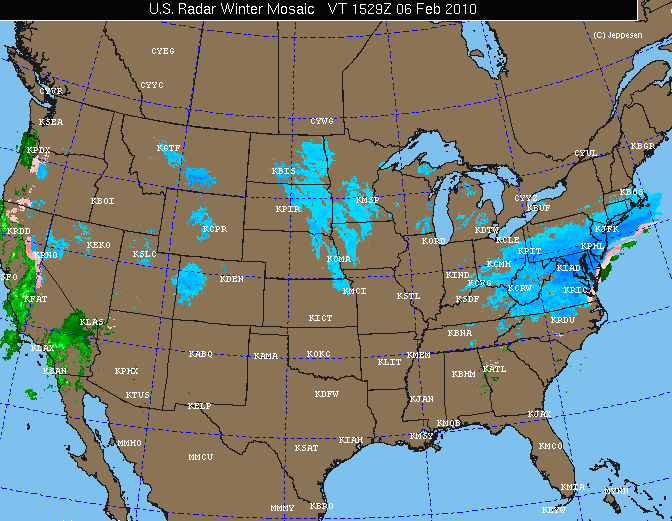
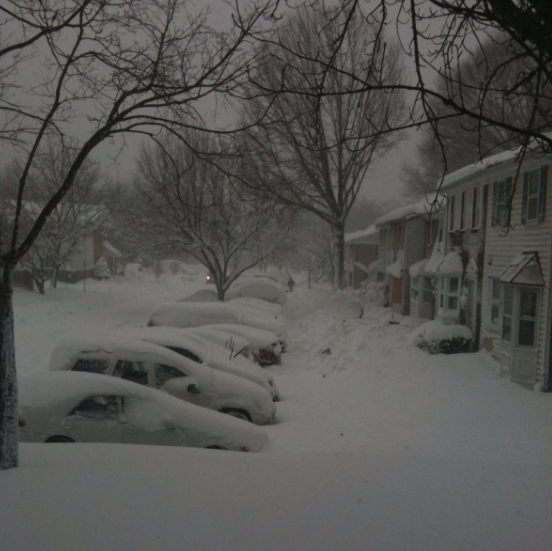
As I am sure you are aware, this small issue called “the worst blizzard Washington D.C. has ever seen” is currently hovering overhead.  It started snowing yesterday around 10am, and I don’t think it has stopped ever since.  Just ask my little brother who is constantly shoveling our sidewalk.  🙂

A 100,000 Foot Overview...

Needless to say, everything in this region has come to a standstill (minus those who think they attended a defensive driving course and are good to drive in over a foot of snow).  I was supposed to start my 4th week of ground school today, but it was canceled.  My flight today was cancelled.  That will make, let’s see, hold on, still counting, an eternity since I last flew.  Maybe next week?  Not with another 3-6 inches expected by mid next week.  At this rate, I don’t even know if I will get out of my driveway by mid next week, let alone be able to fly.

I figured that I would take full advantage of this time, as I have been, to continue my studying.  In addition to my flight training and in classroom ground school, I am attending the online Cessna Flight Training program, which is extremely interactive.  Watching Jon King in those videos, you can deduce one thing: he really enjoys his job (very enthusiastic).

A 6-Foot Overview...

In the end, I picked probably the worst time of year to start my flight lessons.  I was told that during this time of year, many of my lessons would be cancelled.  While I did expect a flight or three to get cancelled, I didn’t think that ‘murphy’ would be lurking around every lesson I have scheduled.  At this rate, if I scheduled a lesson for everyday of the week, I’d get to go up once a week.  Maybe…

~ Brian

Posted by: Brian | January 30, 2010

Jack Frost nipping…

As expected, the cold front moved in and brought a few inches of snow along this morning.  I was hoping it’d wait until later this evening, but it is what it is.  I went in for ground school at 8AM (1300Z – see, I learned something!), and went over Radio Communications at towered and non-towered airports.  Around 10AM, we did a quick review for the quiz and then took it.  There were no real surprises on it, as my instructor is very thorough.  He provided a great study tip, which I use.  Basically, he said to bounce my notes off of the Jeppessen textbook and the Gleim FAA exam study guide.  The Gleim study guide is a collection of ALL potential questions that could arise on the final exam.  Studying the Gleim manual will ensure you pass the exam, however (wait for it…) it doesn’t cover everything you need to know as a pilot.  I tried his approach, and felt very good about the quiz, but I will let you know how I did next week.

After the quiz, we were done for the day.  The snow really started to pound the area, and since some students were coming in from Virginia and northwest DC, we called it for the day.  The short video clip below shows you what it looked like at about 11AM this morning.  Also, I wanted to try out my camera.  Forgive the audio, as it’s a bit low and hard to hear.  It will be very clear once I get the camera mount in the airplane, as I have the audio cable adapter for my headset.  The video was set to “standard” mode, but has HD capability (not as clear as it could be).  The positive to recording in “standard” mode is that you get longer recording capability, as opposed to HD.  The camera is a a 20Twentry Contour HD 720 “helmet” or “bullet” camera.  This is what I will be using in the cockpit, once I get back up.  What I do like about it is, when set in HD mode, has wide-angle capability, which will hopefully minimize the “cramped” look in the cockpit.  I will have to mess around with it to determine the best setting based on length of time in the air.

~ Brian

Posted by: Brian | January 30, 2010

“Shout Out”

This will be a quick post, as I am on my way to ground school.  I simply wanted to say, “Thank you” to John Conway, a fellow student pilot at Freeway Airport, who informed me that Uncontrolled Airspace gave Runway 18 a “shout out”.  The mention is in their January 19th podcast (towards the end of the broadcast).  Uncontrolled Airspace is a trio of flight enthusiasts who “gather in a virtual hanger” to discuss general aviation topics.  Very informative site and podcast.  They can be downloaded for free at iTunes.  Thank you, John, for the heads up.

As I stated, I am on my way to school now.  I am due to go up this afternoon after class, however, snow is expected today, so we shall see.  As always, I will let you know how it goes.

~ Brian

« Newer Posts - Older Posts »

Categories