Posted by: Brian | January 23, 2010

No Flying for the Sick

Right.  So, I have been sick for the past five days or so with sinus congestion. Nothing else.  That makes this that much more annoying, because sinus pressures are enough to keep me from flying.  It’s so bad, I notice the slight variations in pressure just driving up and down Maryland Route 100.  I can only imagine what 2000′ would do to me.  Even if I felt OK enough to go up, the medications alone would keep me from flying.  The FAA has a tight grip on what types of medications pilots may take, and how long one has to wait after taken them.  For instance, I was prescribed antibiotics today for my sinuses.  The FAA requires me to wait at least 48 hours after taking them to ensure no adverse side effects occur.

I spent much of the day in ground school again today.  After discussing most of the [outside] parts of the airplane last week, we touched on the engine this morning, before moving on to the flight instruments, types of airports and charts.  I feel like a mechanic now, although I don’t think you want me working on your airplane.  🙂  We also delved into the “six pack”, or the Airspeed Indicator, Heading Indicator, Altitude Indicator, Turn Coordinator, Vertical Speed Indicator, and the Artificial Horizon (Attitude Indicator).  Not only did we learn what they do, but HOW they work.  This is important for when an instrument fails, you know not only why it failed, but how to either a) fix it or b) use another instrument to do the [generally] same job.  As I have learned so far, there is a lot of redundancy in airplanes for that reason (Magnetos are another example).  After the flight instruments, we talked about the various types of airports (towered and non-towered or controlled and uncontrolled) and how to interact with each.  We ended the day talking about airspaces: A, B, C, D, E, G.  This is a beast in and of itself, which I really need to understand.

Next week, prior to jumping back in to instruction, we will have a quiz on the last two weeks of material.  There will be a total of two quizzes and of course the final exam (on February 27th).  Anyhow, I hope to be back in the cockpit next Saturday after school, but I will have to play it by ear.  Get it?  Sinuses?  Bad joke.  I know…

Posted by: Brian | January 17, 2010

Slow Flight & Stalls

Well, it’s been about a week since I last went up.  Work is getting busier and busier, which means I have less and less time when class is in session.  I am pretty much relegated to the weekends until roughly mid February.  But, I had a good, long day yesterday.  I started ground schooling at 8 a.m. and finished up just shy of 3 p.m..  I had a flight lesson for about 2 hours after ground school ended, so it was a full day.

Ground school was very interesting.  I was extremely nervous, anxious, [insert adjective here] about ground school, mainly because I didn’t know what to expect.  I assumed that I would be the only ‘newb’ in class and everyone else would have tons of experience.  Not the case.  The experience ranged from nothing to “I soloed 15 years ago, but that was it”.  I fell somewhere in the middle, which was nice.  The instructor is a regular around the Freeway Airport and very knowledgeable when it comes to flying.  But what I really enjoy about him is that he ‘dumbs’ it down and puts it into layman’s terms for those of us who aren’t aeronautical engineers. 🙂  We covered the basics, like the types of pilot training one can receive, to the four forces of flight and the parts of an airplane.

After class, I immediately filed my SFRA flight plan and did my pre-flight check.  For those who say, “The third time’s the charm”, you, my friend, are wrong.  It is not the charm when it comes to my camera.  I had a GREAT angle, all was well, but, as in the past, it stopped as we were about to rotate on takeoff.  I found that my camera has a “Drop Sensor” and “Auto Off” function, both of which I disabled.  No dice.  The good news is, I bought a digital audio recorder which I hooked up to my headset and was able to capture the cockpit audio, which turned out pretty nicely.  I could put up the video I have, but it’s nothing but pre-flight checks.

It was a fairly straight foward day, as we started out with some more Dutch Rolls and then immediately jumped into Clearing Turns, Slow Flight and Stalls (Power Off – Imminent).  I must admit, the feeling of the plane just dropping through the air during a stall is a bit disconcerting.  It ony happens for a split second, but enough to make you pucker.  I wasn’t at all scared or nervous, as I’d seen plenty of other training videos and sort of knew what to expect.  But yes, I still puckered up a little.  I guess it reminds me of going to a baseball game and sitting behind the plastic screen.  When the ball is foul-tipped, and is heading right for your face, you KNOW it’s not going to hit you, but you flinch and duck anyway.  I knew I was safe at 2000′ doing this maneuver, but the pucker factor was still there.  Ok, I don’t know if that was a good analogy, but you get the point.  🙂  Overall, it was a good day.  I need to study as much as possible before next session, as I actually do my first takeoff and landing (very nervous!).  Landing is supposedly the most difficult to ‘master’, but I’ll get it eventually.  Afterall, you do takeoff to land…

Attached is the audio from the lesson.  I edited a lot of the dead space out, and stuck pretty much to the lessons themselves, as well as some of the calls I made to the towers.  After going back and listening, it’s amazing how much of a refresher it was, not even 24 hours later.  Hope you enjoy,

~ Brian

Hours / Total Hours: 1.4 / 5.4

Posted by: Brian | January 12, 2010

More Basic Maneuvers.

Yesterday was more of the same as from the previous day.  I needed more work on the Dutch Rolls, which we practiced again.  I am ‘slowly’ getting the hang of the rudder pedals, but not quite there yet.  There is so much going on, between having to scan my instruments, look for traffic and conduct the maneuver that my CFI wants me to, I forget some of the fundamentals such as rudder use.  I am beginning to use my trim more, but I need it to be second nature.  Level out, THEN trim.  As my CFI states, “trim is a poor man’s autopilot.”

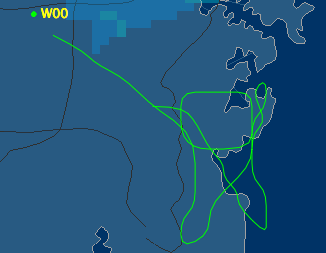
Roughly what the route looks like...

I was also introduced to “Clearing Turns”.  A bit of confusion set in with this one: whenever you bank right or left, you need to lift the wing in the direction you about about to turn to check for traffic.  Once clear, you can commence with your turn.  I heard my CFI say, “Ok, let’s do some clearing turns”.  I thought I had been doing them this whole time any time I needed to make a turn.  Silence ensues in the cockpit.  He then asks, “How do you do clearing turns?”.  Silence.  I knew the answer couldn’t have been as easy as what I have been doing for the past few lessons; there must’ve been something I was missing.  There was.

In a nutshell, any time you are about to conduct a maneuver that requires pitch changes, such as slow flights or stalls, you need to clear your turns.  And no, it’s not the same as simply lifting your wing to check your blind spot.  It’s pretty simple, actually: lift your wing to check your blind spot (ok, so it’s a PART of this maneuver!), then use a bank angle of 30 degrees in the direction you just cleared, check mixture rich during turn.  These turns are always done at 90 degree heading changes.  Once you get to 1/2 of the bank angle of your desired heading, turn the opposite direction and pull the carb heat (again, a 30 degree bank angle and a 90 degree turn).  Bring the yoke back around to straight and level flight while reducing the power to the desired airspeed (depending on the maneuver).  Additionally, you must maintain the altitude.

I promise you, after going through that last night, I will a) never forget how to do Clearing Turns and b) know exactly what I need to know prior to the next training session.  So, before my next session, I need to know how to do Clearing Turns, Slow Flight, Approach to Landing Stalls, Power off descents at Best Glide (65).  We will be doing some more Dutch Rolls, Climbing and descending turns, Constant Airspeed Climbs, and Constant Airspeed Descents.  I am thoroughly enjoying this, but there is a ton still to learn.  Not that it becomes too much easier in the near future, but like anything, once you have the fundamentals down, I don’t care what you say, it does become a bit easier…

Hours Yesterday / Total Hours: 1.4 / 4.0

Posted by: Brian | January 10, 2010

4 Fundamentals & Dutch Rolls

Today went a little better than yesterday did.  I got to the office about 30 minutes early so that I could file the flight plan and do my Pre-Flight Checklist.  After my checks, I mounted my camera.  The angle my camera sits at makes it hard for me to know exactly what buttons I am pushing.  In short, I must have hit the wrong button, so nothing was recorded.  Fail.

Once my checks were completed, I got my CFI and we did a quick run-through of the days objectives.  After that, we headed out to the airplane and got moving.  The taxiing went a bit better today than it did today.  Hey, as long as you are improving, right?  We conducted our “Before Takeoff” checklist and up we went.  Climbed to 700′, turned right to 045 degrees and continued our climb to 1000′, as which point we switched our radios over to Potomac Approach to inform them we were with them.  Once we got to 1200′, we turned right to a heading of 090, and continued our climb to 1400′.  Once we hit 1400′, we turned right to 150 degrees and headed straight out to Deale again.

We started with Dutch Rolls, which is basically turning right and left, and using the rudder pedals to maintaining the current heading.  We found our reference point in the distance to focus on and my CFI demonstrated the demo.  I must say, this wasn’t as easy as it sounded.  My issue was that I didn’t have a proper grip on the yoke, so when turning, I’d either push or pull on the yoke, instead of keeping the altitude of 2000′.  At one point, we’d climbed to nearly 2200′, so I had to descent back down.  My CFI told me [over and over] what I was doing wrong, and at the tail end of the exercise, it began to click.  We then jumped into climbs and descents, and turning while doing so as well.  This went better than the Dutch Rolls did.  We practiced those for awhile, then transitioned to glides and approaches in landing configurations.  Those weren’t that difficult; very interesting.  The planes won’t just fall out of the sky if you lose engine power.  They glide fairly well.  The powered back and hit our glide speed of 65 KIAS for this type of airplane (172).

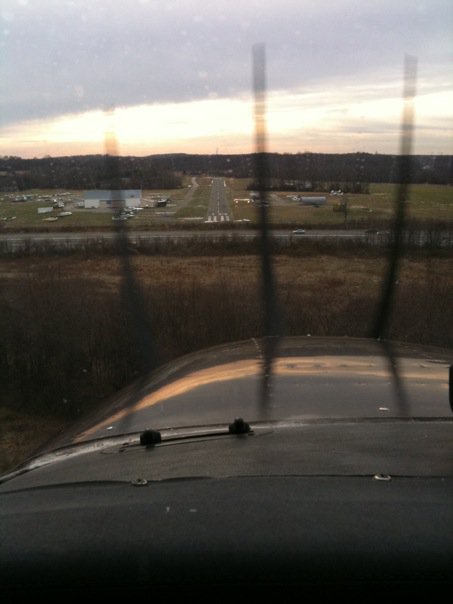
By the end of this exercise, it was about time to head back towards Freeway Airport.  I found our reference point (water tower), reduced our power to 2100 RPM and slowly descended to 1000′, which is pattern altitude.  One the way, we spotted the airport, switched frequencies back to Freeway Tower and turned west over US Route 50 & 301.  We followed the highway and entered the pattern just northeast of Freeway.  We checked for traffic and entered the pattern downwind.  My CFI had me really pay attention to the three major indicators (airspeed, heading, altitude).  We hit 80-90 KIAS downwind and dropped 10 degrees of flaps.  Once the runway numbers were at our 45 degree oblique, we turned base, dropped another 10 degrees of flaps and made the call to tower.  This was immediately followed by turning for final and adding the last 10 degrees of flaps.  Again, the crosswind was hitting us on our left, but my CFI made the landing with no issues.  We taxied back to our parking spot and completed the last portion of the checklist.

It was a fairly straight forward day.  I had some issues with the Dutch Rolls, but I think that was kind of expected.  I made one radio call today to Freeway Tower, which was a basic radio check. “Freeway Unicom, N400GE, Radio Check”.  I will be making more and more calls with every outing.  Anyhow, I tied down the airplane and headed back in.  We closed out the ticket for the day and discussed what we’d be doing next time, which is a lot of what we did today.  I hope to also have the technical issues sorted out with my camera for next session.  Ok, user-error, whatever…

Hours Today/Total: 1.1/2.6

Posted by: Brian | January 9, 2010

Four Fundamentals of Flight

First and foremost, I did have my camera mount up today in the cockpit, however, the angle wasn’t set properly, so you saw a lot of the instruments and my back.  Not to mention, I did get my audio cable in today, however, I’m missing an adapter, so the audio wasn’t where I wanted it to be.  There is only so much you can hear with the engine up and running.  I hope to get the adapter in later this coming week, so until then, the audio won’t be great.  So, I will ensure that tomrrow’s session is a better video recording, though.  Hey, it’s trial and error, right?  Video aside, here is a synopsis of how my afternoon went…

I made it up again today, and it was fairly unexpected.  My lessons had been cancelled all week due to the high winds in the area.  This weekend was supposed to be no different.  After cancelling yesterday, my CFI said that we’d be meeting up today regardless, to go over some more ground issues and to prepare me for my ground school starting a week from today.  I got to Freeway Airport about 10-15 minutes early today, and immediately checked the windsock.  It wasn’t fully inflated, which was a nice sight.  I can’t remember the exact knots, but if it’s fully inflated, it simply tells you the direction of the wind and that the wind is over 15 knots.  When I entered the office, I checked the wind speed indicator, which was reading about 9 knots, with gusts up to about 15-18 knots.  So, I was hopeful that we’d get in the air today, but wasn’t holding my breath.

As I was about 15 minutes early, I just watched other C-172’s fly over and land.  Pretty much on the dot, my CFI exits one of the Cessna’s and approaches the main office.  He looks around, closes out the student’s file for the day, looks over at me and asks if I’m ready to go up today.  I don’t think “yes” came out fast enough.  We immediately got to work; he had me file the DC SFRA flight plan, which was the second one I did.  This time around was a bit smoother.  When filing, you are supposed to state that you are a student pilot, in an effort to get Flight Services to slow their roll a bit, ensuring I get everything.  The last time, I don’t think the guy cared much.  This time, he was very understanding of my position as a student pilot.

After filing the flight plan, we went out to the aircraft we’d be in for the day, this time with me conducting the Pre-Flight checklist on my own (with him watching of course).  I must say, with a week of not flying, I had a ton of motivation to study, so it went fairly smooth.  I forgot a few things, but it’s expected this early in the game.  Once the pre-flight was completed, we went back to the classroom, where we discussed the objectives for today’s flight.  The primary objectives were to work on the 4 Fundamentals of Flight: Straight and Level Flight, Turns, Climbs and Descents.  After ensuring I understood what we’d be doing, I called to receive our Squak Code fand frequencies for the day and headed back to the plane.  We untied the final tie-down and went through the “Starting Engine” checklist.  This was all pretty straight forward, as are most of the checklist procedures (PS – always follow the checklist.  Don’t try to memorize it).  We entered our Squak Code and frequencies, and started our taxi…

Now, steering an airplane is NOTHING like steering a car.  You use the rudder pedals, brakes and throttle (not the yoke).  My CFI taxi’d to about the midway point, and once we got on a straigh-away, he let me take over.  This was probably the most difficult part of my day.  I wasn’t ever providing the right amount of input.  You really have to depress the pedals all the way down and keep it there.  They are spring loaded and take a second to take affect.  Providing quick inputs (like I was doing) doesn’t really do much.  So, needless to say, my CFI had to jump in a lot and assist.  I will get it.  Eventually.

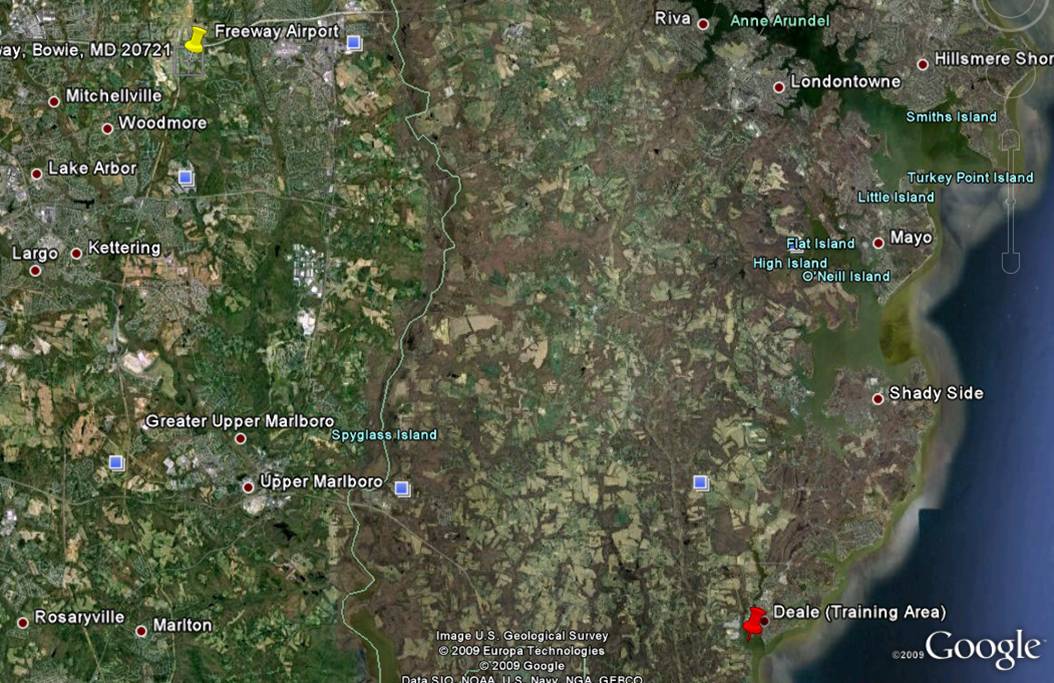
We pulled up to Runway 36 and held short.  We jumped into our “Before Takeoff” checklist, and pulled onto the runway.  My CFI explained that we rotate at 55 KIAS (the minimum speed needed to pull the plane off of the runway (Vr) for this type of airplane and that we will climb at best rate (Vy), which is 74 KIAS.  We increased throttle and began our takeoff.  Like he said, at 55 KIAS, we rotated off of the runway.  We climbed to 700′ at 74 KIAS, turned right and exited the traffic pattern 45 degrees from our heading we were on.  We continued the climb to 1200′ then turned right to a heading of 090 degrees (if I remember correctly).  Our training area is always over Deale, MD, which is southeast of the airport.  Our crusing altitude was 2000′ when all was said and done.  There was a bit of turbulence, but it was expected as the winds were 10-15 knots.  Nothing too scary.  It didn push us around a bit on the landing, but I’ll get to that later.
Freeway Airport to Deale

“Keep your head straight and stop leaning on me”.  We immediately jumped into the 4 Fundamentals of Flight, starting with turns.  He had me doing 30 degree turns, keeping the plane at altitude (2000′), while keeping the ball centered in the turn coordinator (using the rudder pedals).  Another issue I had (albeit only briefly until I remembered) was to keep my head straight in turns.  I would lean into the turns as if I were on a motorcycle.  This is highly frowned upon because if you try to keep your world level, then you may forget that the plane is in a turn, which could be devastating in the end.  Now, if I can just remember that for tomorrow’s lesson.  Anyway, we breifly worked on climbs and decents (naturally on the decents, as we had to land).  After about 30 minutes of turns, turns and more turns, we headed back to Freeway Airport.

Another objective was to read your terrain and use “pilotage” to navigate back.  He pointed out a distant water tower, near the airport.  As we got above the tower, we turned left and followed US Route 50, made another 45 degree left turn to enter the traffic pattern downwind.  As we did that, the airport was to our right.  At our 45 degree, we made our turn for base, closely followed by our turn on final.  Although I didn’t land the plane, he wanted me to keep my hands on the yoke and feet on the pedals to ‘feel’ what he was doing.  As mentioned above, we had a good head wind, which pushed us around a bit.  But my CFI is pretty awesome and landed with no issues.  After landing, we taxi’d off of the runway and back to our parking spot.  We ran through our “Securing the Airplane” checklist, which was pretty smooth.  After tying the plane down, we proceeded back to the office and closed out the ticket.  He told me what I needed to think about before tomorrow’s lesson.  No, quitting wasn’t it.  🙂  Just about some of the procedures for takeoff (checklists, etc) and to think about what we did on the turns and how to do those.  My CFI said that I had a good day today.  I think it went fairly well.  I wish I’d have done better maneuvering on the ground, but I think I will get plenty of practice at that down the road.  I have another session tomorrow, followed by early next week as well.  Again, my goal is to fly at least 2-3 times per week.

Hours Today/Total Hours logged: 0.9/1.5 hours

Posted by: Brian | January 6, 2010

Intricacies of Learning to Fly, Part I

Since I am waiting for the weather to stick it’s proverbial tail between its legs and run, I decided that I will post a ‘quick (yeah right) blog on some of the background issues to think about when deciding if flying is for you.

GI Bill: First and foremost, being a veteran of our Armed Forces, I immediately thought that I’d be able to use my Montgomery G.I. Bill towards paying for the training.  Sadly, I was mistaken.  The Department of Veteran’s Affairs will only pay for training that directly leads to becoming an Airline Transport Pilot (ATP) or receiving your instrument or commercial ratings.  And even then, they will only reimburse 60% of the costs.  Source: VA Website.  It’s a bit disappointing that I cannot use the remaining balance of my G.I. Bill on this training, but won’t deter me from continuing.  So just know, if you are going for your PPL (Private Pilots License), it’s out of pocket.

Cost: Another question I get a lot revolves around the cost.  This varies by location, aircraft type used during training, required hours of airtime before being endorsed to take the FAA Flight Exam, and any special flight club or school specials or deals.  For instance, my flight school offers a 10% discount on aircraft rentals if you set up a block account of $1,000.  As you close in on $1,000, you ‘recharge’ the block account back to the full amount.  By the way, paying for flight school is sort of a ‘pay-as-you-go’ deal.  I guess that you could pay for it up front, but I would imagine that the final amount wouldn’t be very accurate, as you will never know from the very beginning exactly how many hours you will require.  The FAA minimum is 35-40, depending on whether your schooling Part 61 or 141.  However, the student pilot average prior to taking the FAA exam is anywhere between 60-80 hours.

Additionally, ground school is not required for your PPL (depending on 61 or 141).  Note: A pilot is certified to fly under authority of Parts 61 and 141 of the Federal Aviation Regulations (FAR), not to be confused with the Federal Acquisition Regulations (FAR) :).  So, Part 141 is more structured than a Part 61 is.  There is a lot more to it than that, but that is the cliff-note version.  Anyhow, the training you receive on the ground would reduce the amount of hours you would need in the air.  The costs would be reduced because the ground school (which the prices would differ from place to place) is much cheaper than airtime.  As an example, the ground school I will be attending costs $249 (a 7-week course), plus another $350 for the ground school kit.  The kit includes everything you will need for the training.  The $600 you spend on ground school is a drop in the bucket compared to what it would cost an instructor to teach you much of the same material in the air.  Not to mention, it will make you a better pilot in the end, as much more information is covered in ground school than is covered one-on-one with your instructor.

How long does it take: I don’t know.  I am not done.  🙂  But what I can tell you is what they told me: it depends.  It can take as little as 4-6 months (which is what I am shooting for) to complete or much longer.  It boils down to how often [per week] you can fly.  As an example, if I can average 2-4 sessions a week, I am looking at 4-6 months.  With my schedule, that will entail flying double sessions on the weekends when my weekdays become hectic.  However, at this rate with the wind, I am looking at 4-6 years.  My CFI (Certified Flight Instructor) told me that they have a student who has been working on his for 3-4 years now.  It will also depend on your funds available to spend on the training.  Obviously, if you can’t pay for it, that will put a damper on things as well.  I think many flight school have financing options available if you cannot afford to pay for it up front.  So, as with everything else pertaining to flight, there are many variables.  But if you love it as much as I do, you will find a way!

“When once you have tasted flight, you will forever walk the earth with your eyes turned skyward, for there you have been, and there you will always long to return.” – Unknown

Posted by: Brian | January 4, 2010

Wind, wind and more wind…

The winds are still hovering around 15-20 knots, with gusts in the upper 20’s.  While the weather is getting better by the day, it’s not improving quick enough.  My next scheduled lesson is set for Wednesday afternoon, but if tomorrow is decent, I hope to get in then.  To be honest, the rest of the week isn’t looking too promising.  The forecast shows mid-teens, with gusts in the upper 20’s, low 30’s all week.  Boo.

On a positive note, my H10-13.4 David Clark headset arrived, along with my kneeboard.  So, when I do get to go up next time, I won’t have to swap spit with about 100 other people that used the rental headsets.  Additionally, I have been burying my head in the V-speeds and pre-flight operations.  Matt, my CFI, suggested that I get a Cessna 172 Cockpit poster for training purposes to assist me with cabin pre-flight operations.  I purchased mine from The Pilot Shop, which arrived today as well.  Still waiting on the camera mount and audio cable.

My seven week ground school starts on the 16th of January, which I am both looking forward to and nervous about.  It’s not required for the Private Pilots License (PPL), but it is required if you want an Instrument Rating, which I will want.  The instrument rating is obtained after receiving the PPL.  Anyhow, it’s every Saturday for seven weeks, from 8am – 3pm and figured I might as well knock it out now.  I am trying to get a buddy of mine to join me in the ground school portion, which would be awesome (Come on, Tom!).  Either way, I am looking forward to it.  I am hopeful that the weather will improve this week, but not holding my breath.  I’d really like to get a few hours in this week, especially since my workload picks up next week.  Things happen for a reason and end up working out in the end, though…

~ Brian

Posted by: Brian | January 3, 2010

50 knots will do it…

This was sort of expected: no flying today due to winds of 35 knots and gusts up to 50 knots.  I don’t think that there are too many student pilots out there today.  On a positive note, it gives me time to study the Pre-Flight checklist, which I will be doing on my own the next time, with Matt’s supervision.  He said that after the next time, I will be doing it myself, while he waits in the warm office.  🙂  Additionally, it allows me time to study the Cessna 172’s airspeeds for normal operations, airspeed limitations (Va, Vne, Vs, Vso, etc), airspeed indicator markings and powerplant limitations.  I need to start putting this to memory.  Some of it I know, much of it I still need to work on.  I should have a better understanding by the next session, however.

I should have my Sticky Mount tomorrow for my camera, as well as my audio cables for my headset, so I hopefully I will have some podcasts to post this week from the cockpit.

~ Brian

Posted by: Brian | January 2, 2010

No Airtime Today :(

So, I was super excited to get back up in the air again, but the wind would not play along today.  I got in about 745am this morning (15 minutes early) and met some of the other CFI’s.  They all seem pretty cool and make you feel pretty relaxed (which is very important anytime you are learning something which creates stress…unless you are a Navy Seal).  Anyhow, the winds at Freeway Airport were hovering around 25 knots, with gusts around 36 knots.  While those may be fine for students a bit further along, they were not great for me in only my second lesson.  Instead, Matt (my CFI) decided to go over the Pre-Flight Checklist for the Cessna 172, which is what I fly.

We stepped outside in the below-freezing weather and headed to the Cessna 172.  If I remember correctly, the thermostat read 26F.  Then, add 25-35 knots of wind, and that makes for a pretty cold morning.  I seriously thought at one point that frostbite would set in.  We approached the plane and immediately started going down the Pre-Flight checklist.  I was glad to hear that our checks would start in the cockpit.  While the heater inside wasn’t on, it felt warm compared to Antarctica outside.  We systematically went through the list, covering each item on it in-depth.  What I liked about it was that Matt also explained why certain gauges on the instrument panel worked and how.

Once we completed the interior portion of the check list, we stepped outside to complete the exterior portion.  While many of the checks we do is based on what you see, some of it is also based on what you feel (btw, very difficult to do when you can’t feel your fingers).  It started with checking the fuel sump, which requires draining.  I got some of the fuel on my hands, which made things worse with the cold.  * Note to self: Don’t get fuel/water/anything wet on your hands when it’s below freezing with a windchill factor.  Just saying.  We checked everything from the fuel sumps to katter pins to static ports.  The last two items on the checklist were a general walk-around and to check the windscreen.  Once we completed those, we went back to the cockpit, turned on the Master Switch (Battery Only) to raise the flaps.  They were fully retracted in order to view the tracks, weights, nuts, bolts and katter pins.  We killed the power to the Master Switch, replaced the Control Lock, grabbed our now-cold coffee and returned to the main building.

Once inside and de-thawed, Matt explained how to file a flight plan, as well as the weather briefing procedures.  If you are not familiar, being within the DC SFRA (DC Special Flight Rules Area), which is a 30 mile radius around Washington DC, we have to file an SFRA Flight Plan.  Matt told me how to do it, then made me call Flight Services and do it myself.  I must admit, I was a bit nervous, but once Flight Services answered, I rolled right along.  The biggest issue for me was that they just spit out the information, but if you aren’t familiar with the order or how it’s supposed to sound, some of the information is lost.  You can ask them to repeat themselves, but they never sound too happy, so I didn’t.  I was just happy I got most of the information.  It will come with time, I’m sure…

That concluded my training for today.  My next session is scheduled for tomorrow afternoon, but the winds are supposed to be worse than today was.  So I went ahead and scheduled a session on Monday as well.  My David Clark headset I ordered should be in by then; I can’t wait!  The Sticky Pod mount and cables should be in soon too.  My next lesson, we will be in the air, so that is refreshing to know.

One very important lesson I learned today was, no matter how cold the weather is, if you plan to fly, you MUST abide by the checklist.  I would imagine that these are times when complacency tends to set in; not necessarily because one is lazy, but other factors as well (for instance cold weather).  There are very few second chances in flying.  One quote from Matt today: “It’s better to be on the ground wishing you were flying than the other way around.”

~ Brian

Posted by: Brian | January 2, 2010

Welcome to Runway 18!

Hello and Welcome to Runway 18!

My name is Brian and I am a student pilot flying out of the Maryland area.  I got my inspiration to document my flight experiences from several other aviators who did the same thing.   Prior to my first flight, I was extremely anxious, mainly because I did not know what to expect.   I scoured the internet looking for other personal experiences when I ran across Greg Summers over at Student Pilot Journal.   As a newbie, I not only got a feel for what to expect, but was granted unfettered access to the cockpit via Greg’s onboard camera.

With Runway 18, I plan to document my own personal experiences for not only myself to look back on later, but for those of you interested in a private pilot certificate and wondering what it will entail.   The plan is to have my HD camera in the cockpit with me, but it may be another week or so before that happens (possibly a bit longer).  I am waiting on a camera mount I just purchased, which should be in soon.  I ordered it from StickyPod, along with an audio cable to hook up to the headset for better audio quality.  I plan on passing on my thoughts, at a minimum after each lesson, along with a video podcast.   Thanks again for stopping by and shoot me an email with any questions you may have.

~ Brian

« Newer Posts

Categories